

August 6/19, 2026
My heartfelt greetings to you all on the Feast of the Lord’s Transfiguration.
On this day in 1934, Archbishop Anastasy (Gribanovsky), the future First Hierarch of the Russian Church Abroad, tonsured in Jerusalem Nun Mary (Robinson), the first abbess of St. Mary Magdalene Gethsemane Convent in the Holy Land, into the Small Schema. I am sharing the homily he delivered on that occasion, courtesy of Archimandrite Roman (Krasovsky), head of the Russian Ecclesiastical Mission of the Russian Church Abroad in Jerusalem.
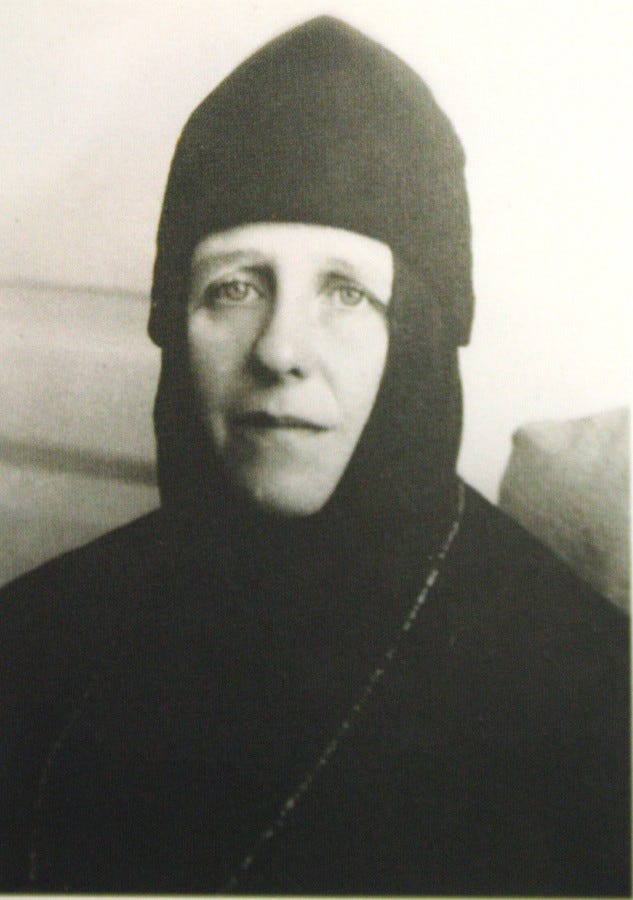
Abbess Maria (Robinson) of the Gethsemane Convent in Jerusalem (1896–1969)
And so, the desire of your heart has been fulfilled. On the radiant feast of the Transfiguration of the Lord, with a resolute and courageous heart you have entered upon the path of a new life, so that, having cast off all the works of darkness, you might walk in the light that transfigures man into the glory of God. You have not only received the angelic habit, but have truly put on Christ, for monasticism is “a life according to the likeness of the Lord,” as you heard in the moving rite of tonsure.
If you now unroll before yourself the scroll of your life—still brief, yet already rich in experience—you will see that all the paths along which the hand of Divine Providence has led you until now have been drawing you toward this present day.
You came to us from another nation and from another ecclesiastical fold. Yet in every nation there are those who fear the Lord. In every Christian land there are people upon whom He sets His seal from their very birth and whom He draws to Himself by ways unknown to man. Everywhere there are chosen souls who, like Samuel, hear the call of God from childhood. You were one of these.
The summons from heaven touched your hearing early, and neither the noise of worldly vanity nor any songs of the earth could afterward drown it out in your heart. At times, as you yourself have acknowledged, the powers of darkness rushed upon you, ready to engulf you; yet you possessed a lamp burning brightly within your soul, and the darkness did not overcome it. Even then you loved the Heavenly Bridegroom with all your heart. For His sake you renounced all the pleasures of youth and entered a monastic community, later dedicating yourself to self-sacrificing missionary service in India. Yet an inner voice told you that the first and fundamental purpose of a Christian must be to know the truth—that is, to embrace the pure and uncorrupted Christian teaching and to partake of the fullness of the Church’s life of grace.
Finding neither the one nor the other in the community to which you then belonged, you hoped to supply what was lacking through so-called Anglo-Catholicism—that branch of Anglicanism in which it most closely approaches the Orthodox Church.
Indeed, what brought the great Oxford Movement into being a hundred years ago—of which Anglo-Catholicism is today a continuation—if not the desire of the most zealous Anglican believers to restore the lost connection with the ancient, one, Universal Church, the living memory of which has never entirely died within Anglicanism? The Eastern Orthodox Church, however, possesses this advantage over other Christian confessions: she has never broken that organic unity with the ancient Apostolic Church, but has remained faithful in all things to its spirit. This has given her the strength to preserve within herself the fullness of truth and grace bestowed upon His Church by her Divine Founder, Christ. With your discerning vision, you perceived this as soon as you drew nearer to Orthodoxy, and your heart was irresistibly drawn toward it.
What at first had been only a dim presentiment within you became a firm and conscious conviction when, by the unseen direction of God’s will, you came to Jerusalem—to the Mother of Churches, planted here by Christ Himself and His Apostles. The lofty and instructive example of Grand Duchess Elizabeth Feodorovna, who rests beneath the vaults of this church and who, like you, came to know by experience the incomparable spiritual riches of Orthodoxy, put an end to your final hesitations. Having come to know the truth, you did not confer with flesh and blood; and, like her—the great martyr who from this time forward has become the guiding star of your life—you entered without hesitation through the door of that Church for which your soul and your Christian conscience had long been searching.
Even before you entered into communion with Orthodoxy, you had already clearly sensed that monasticism is the highest embodiment of the Christian ideal, and in practice you had already set foot upon the path of monastic struggle. Orthodox teaching deepened for you the very meaning of monasticism, while the Orthodox Church now gives you special grace worthily to pursue this truly superhuman path of life, more heavenly than earthly.
In the radiance of the light of Tabor—which from this day forward will forever illumine for you the day of your complete betrothal to Christ—the lofty meaning of monasticism is revealed with particular clarity. What is monasticism in its essence if not a continual ascent to the mountain of the Lord and an entrance into the glory of the sons of God? From the furnace of prayer into which the God-Man entered upon Tabor there came forth, as it were, and shone the wondrous mystery of His Transfiguration. Constant prayer, joined to the subduing of the flesh and the freeing of the spirit from earthly attachments, likewise becomes for the ascetic the wings that bear him upward. It transfigures not only his soul but even his body, permeating it with a special, unearthly light.
This light shines within him from inside—that is, from the grace dwelling within him—and passes through his body as fire shines through the crystal of a lamp; or, better still, as the divine light upon Tabor shone through the veil of the Savior’s flesh. And just as this wondrous light became for the Apostles who were bathed in its radiance a source of perfect spiritual joy, filling and even overflowing their hearts, so even the faintest reflection of that same light brings the ascetic the greatest sweetness, with which no other consolation on earth can compare. Whoever has tasted it even once in his life will never forget its uplifting and life-giving breath. And when grace flows into the ascetic’s heart in a mighty and unceasing stream, human language has no words adequate to express his inward blessedness.
Truly, it is good for man to dwell upon the spiritual heights—upon the mountain of the Lord. There he attains such fullness and abundance of life that he is ready to exclaim together with Symeon the New Theologian: “I delight in His love and beauty. I become a partaker of light and glory; my face shines like that of the Beloved.… I am fairer than the fair, richer than the rich, stronger than the strongest.”
Strive, then, to acquire this unfading beauty, this incorruptible treasure, this all-conquering power of Christ.
These are the gifts for which the Church prayed on your behalf today as you pronounced your vows before the altar of the Lord. For these gifts, surely, your heavenly patroness, St. Mary Magdalene, the patroness of this church, also intercedes on your behalf. And with her, we believe, Grand Duchess Elizabeth Feodorovna, who rests here, joins her bold prayers—the one whose example inspired you to leave behind what is earthly and corruptible and to seek what is incorruptible and eternal.
From the earthly Jerusalem that lies before your eyes, direct your gaze toward the heavenly Jerusalem, to which the Divine Son once raised His Most Pure Mother from this very place, that He might crown Her with a heavenly crown for Her wondrous virtues.
Always stretch forth your hands to Her in moments of temptation. May She Herself be your Intercessor, Guide, and Instructor; may you find in Her your refuge, protection, and joy.
Finally, here in this mysterious Gethsemane, always look upon Christ Himself, Who first showed us the way of spiritual struggle, Who wrestled and labored here in prayer even unto a bloody sweat, so that, having Himself been tempted in all things, He might help those who are tempted as they follow in His footsteps. Through suffering and struggle He attained perfection and entered into His glory. Through self-denial and the Cross, if you patiently bear it to the end, you too will become a partaker of His glory.
In sorrow as in joy, always call upon Him, your beloved Bridegroom, until He crowns you, His chosen bride, with wondrous beauty and sets you as a seal upon His hand (Song of Songs 8:6). He will draw you to Himself with invisible bonds of love, and your soul will seek Him everywhere. Even while you sleep, your heart will keep watch and listen to His most sweet and beckoning voice:
“Arise, my love, my fair one, and come away. For behold, the winter is past; the rain is over and gone. The flowers appear on the earth; the time of singing has come, and the voice of the turtledove is heard in our land. The fig tree puts forth its buds, and the vines in blossom give forth their fragrance” (Song of Songs 2:10–13).
And your soul will tremble with holy exaltation as it hears the voice of the Beloved; it will hasten to meet Him and will blossom like the narcissus, like the lily of the valleys (Song of Songs 2:1), beneath the rays of His grace.
Then your whole life will become as though an unending, fragrant springtime, and it will be good for you, as it once was for the Apostles upon Tabor.
Amen.
August 6/19, 1934
Convent of St. Mary Magdalene, Jerusalem
This Day in the Life of the Church an Year Ago:
August Reflections: Transfiguration, Diaspora, and the Fourth Crusade

Beautiful!
Спаси Господи. С праздником!