
The Forerunner’s Head and a Bishop’s Life

February 24/March 9
The First and Second Finding of St. John the Forerunner’s Head is commemorated on this day according to the Church tradition.
Yesterday a friend of mine, also a deacon, told me that when he was growing up he often wondered: “Why did they lose St. John’s head in the first place?” I had written about this question last year, so it came in handy—I am reposting that reflection here in a revised and expanded form.
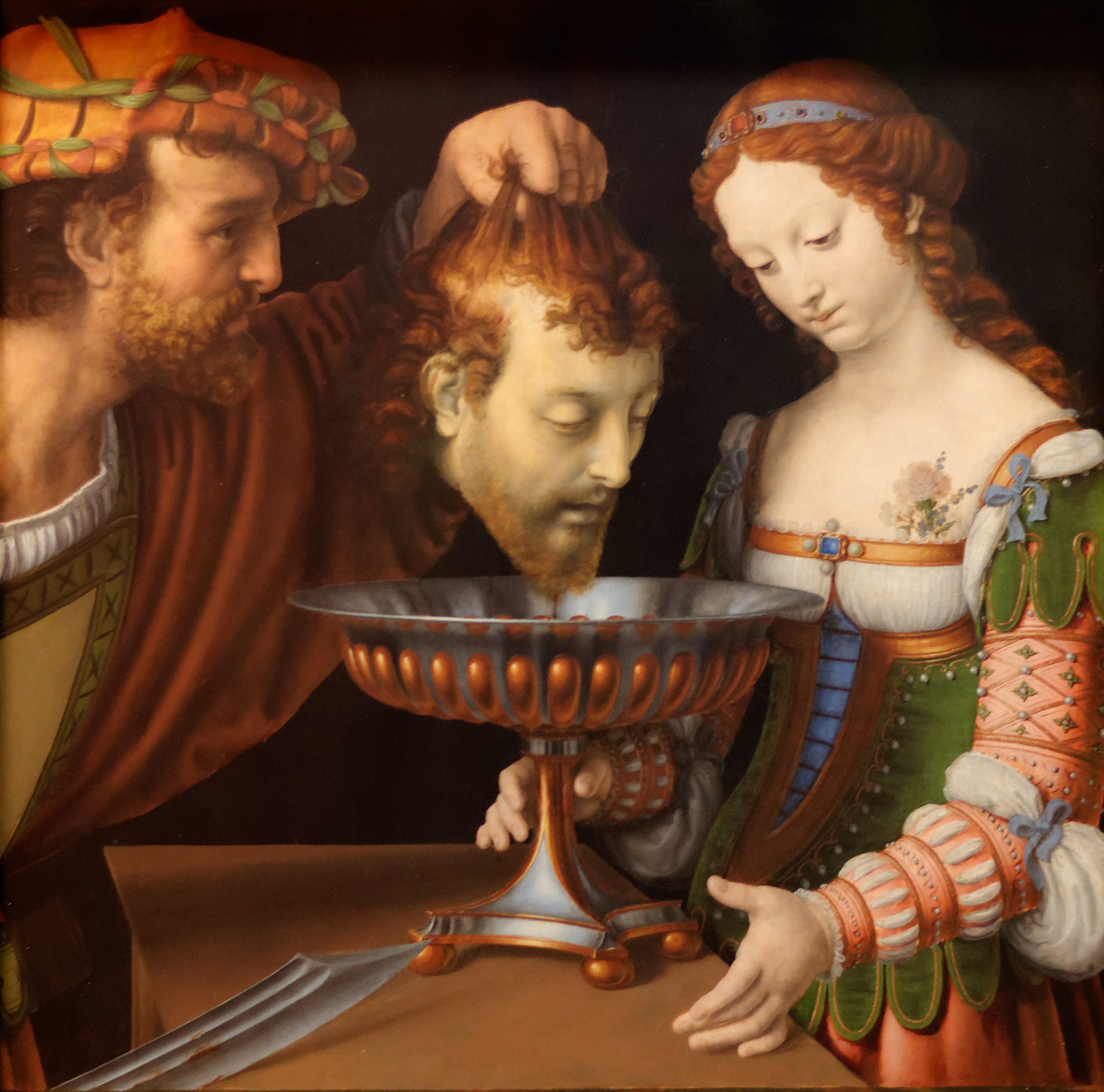
Salome, Herodias’ daughter, receiving the Head of John the Baptist. Andrea Solario (c. 1520–1524). Kunsthistorisches Museum, Vienna
First Finding of the Head of John the Baptist
“On Herod’s birthday the daughter of Herodias danced for the guests and pleased Herod so much that he promised with an oath to give her whatever she asked. Prompted by her mother, she said, ‘Give me here on a platter the head of John the Baptist.’ The king was distressed, but because of his oaths and his dinner guests, he ordered that her request be granted and had John beheaded in the prison. His head was brought in on a platter and given to the girl, who carried it to her mother. John’s disciples came and took his body and buried it. Then they went and told Jesus.” (Matt.14: 6-12, NIV).
According to Church tradition preserved in the Byzantine Synaxarion, the head continued to denounce Herod and Herodias. Herodias pierced with a needle the tongue that had rebuked her and buried the head in an unclean place. She did not allow the head of the Forerunner to be buried together with the body of the saint, fearing that if his body were buried together with the head, John would rise again and once more denounce her.
Knowing of this sacrilege, Joanna, the pious wife of Chuza, the steward of Herod’s household (mentioned in Luke 8:3), secretly took the holy head, placed it in a vessel, and buried it on the Mount of Olives, on one of Herod’s estates near Jerusalem.
When rumors of Jesus’ preaching and the miracles He performed reached the royal palace, Herod Antipas began to fear that John had risen from the dead. The Gospel records this misunderstanding (Matt. 14:2; Luke 9:7–9).
Many years later—according to tradition in the fourth century—the estate where the head had been buried came into the possession of a pious nobleman named Innocent. When he began building a church there, workers digging the foundation uncovered a vessel containing the head of John the Baptist. Signs and miracles revealed the greatness of the relic. This event became known as the First Finding of the Head.
Before his death, fearing that the relic might be desecrated during future persecutions, Innocent again hid it in the same place. Afterward the church fell into ruin, and the location of the relic was forgotten.
Second Finding of the Head of John the Baptist
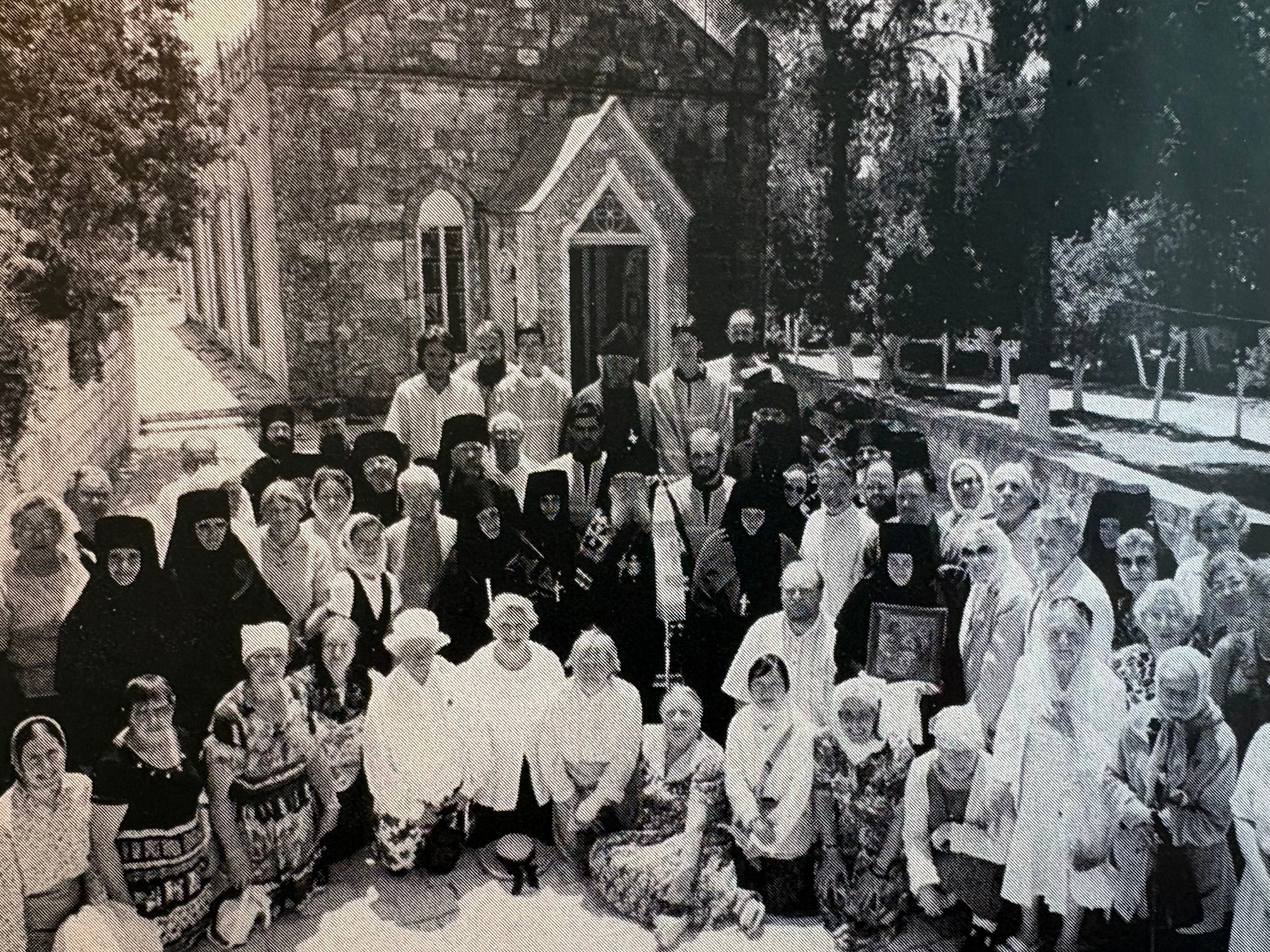
Mount of Olives, Jerusalem — The church of the ROCOR Convent of the Ascension marks the site where the head of St. John the Baptist was found. In this photograph (summer 1998) pilgrims from ROCOR’s American dioceses are seen with Archbishop Laurus, the fifth First Hierarch of the Russian Church Abroad (2001–2008). On his left stands Reader Nicholas Olhovsky, today the First Hierarch of ROCOR.
Many years later, during the reign of St. Constantine the Great (306–337) and the renewed Christian interest in the Holy Land initiated by St. Helena, pilgrims began traveling to Jerusalem in great numbers.
According to tradition, two monks from the East came to venerate the Holy Sepulcher and the True Cross. St. John the Baptist appeared to them in a dream and revealed the place where his head had been hidden.
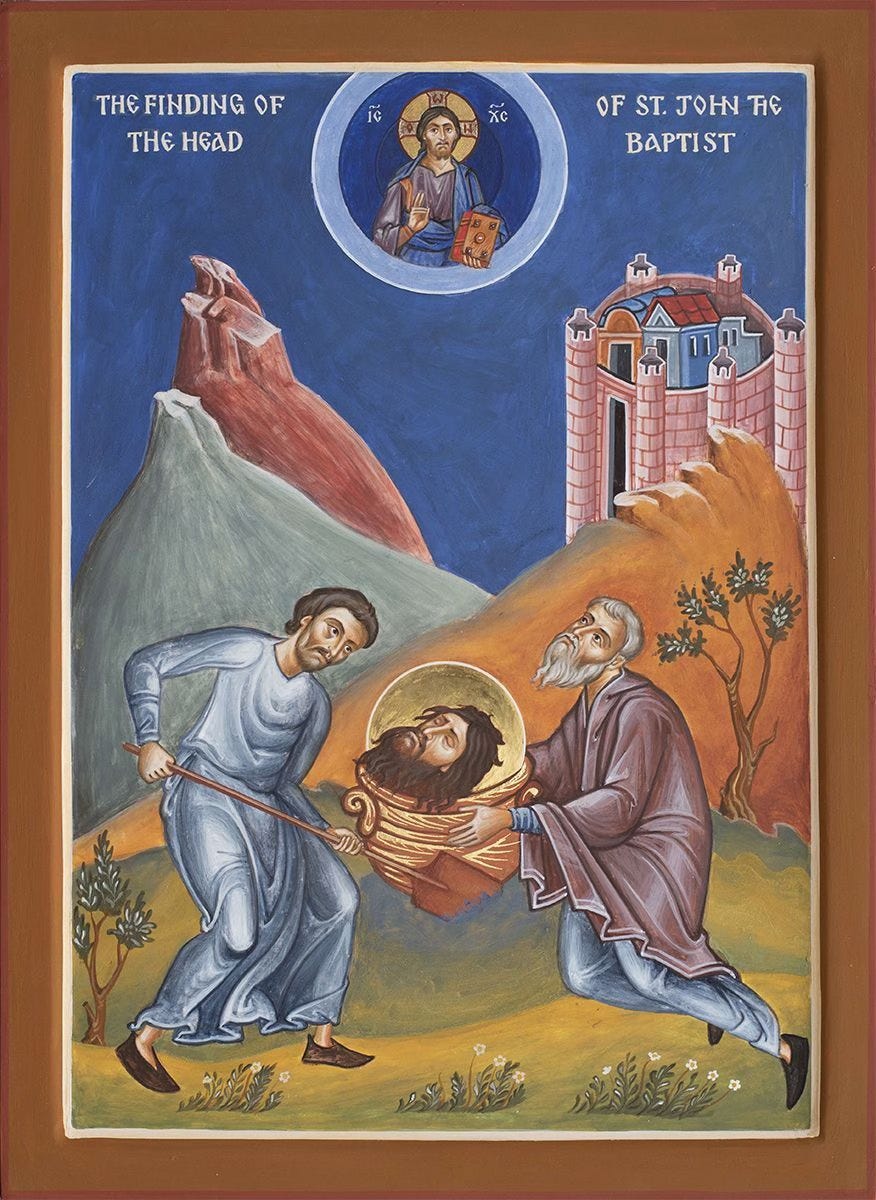
Icon: Nikolaj Mitra Facbeook
After finding the relic, they began their journey home. On the way they encountered a poor potter from Emesa in Syria (modern Homs), who was traveling in search of work. The monks entrusted him with carrying the bag containing the relic. According to the tradition, St. John appeared to the potter and instructed him to keep the relic and leave the careless monks.
The potter returned to Emesa and kept the relic with great reverence. According to the Synaxarion tradition, the head remained there, passing quietly from one devout guardian to another.
Eventually it came into the possession of a monk named Eustathios, who held Arian views. Although he attributed miracles to himself, the healings came from the grace emanating from the hidden relic. When his false teaching was exposed, he was expelled and hid the head in a cave. Over time a monastery was established at that place.
The Second Finding of the Head took place in AD 452 during the reign of Emperor Marcian (450–457). According to contemporary tradition preserved in later hagiographical sources, the head was revealed in a vision to Archimandrite Markellos, the abbot of the monastery near Emesa. Shortly afterward Bishop Uranius of Emesa confirmed the discovery.
On February 26, 452, the relic was solemnly transferred to the newly built church of St. John the Baptist in Emesa. Numerous healings and miracles were reported during these events.
Later the head was transferred to Constantinople, where it remained until the period of Iconoclasm (8th–9th centuries). During those turbulent years pious Christians removed the relic from the capital and hid it in Comana, where it would eventually be discovered again—an event remembered in the Church as the Third Finding of the Head of St. John the Baptist (c. 850), commemorated on May 25/June 7.
A Life Dedicated to the Russian Church
Bishop John (Legkii) of Rockland passed away on this day in 1995.
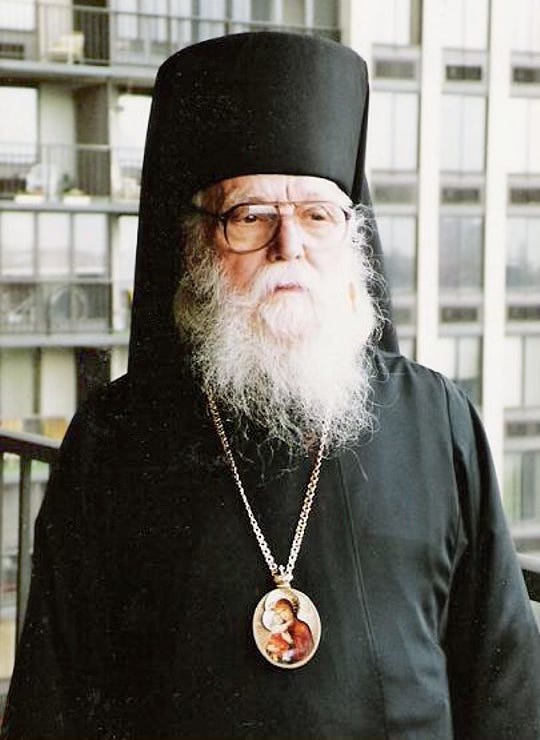
Bishop John (Ioann Legkii, 1907-1995) of Rockland County, NY, a vicar of Eastern American Diocese of the Russian Orthodox Church Outside of Russia
Several of my first impressions upon coming from the USSR to study at Holy Trinity Seminary are connected to Bishop John (Legkii). I came to Holy Trinity Monastery in Jordanville in August of 1990 and happened to be there at his monastic tonsuring. Then at the Synod of Bishops in New York at the All-Night Vigil for the feast of the Dormition. Despite the fact that Bishop Gregory (Grabbe) had fallen out of favor in 1986, Fr. John thanked him at the nomination. For me, this fidelity to an old friend was a sign of his quality character. I was at his episcopal nomination (narechenie) and the next day held a arkhieratikon (chinovnik) for Bishop Gregory (Grabbe) during Bishop John’s consecration at the Novo-Diveevo convent in Spring Valley, NY.
Ivan Savvich Legkii was born on April 29, 1907, in the city of Dvinsk (now Daugavpils in the Republic of Latvia) in Vitebsk Province of the Russian Empire into a priest’s family. After graduating from the Dvina Russian Gymnasium and the Riga Theological Seminary, he studied theology at the Orthodox department of the Theological Faculty of the University of Riga.
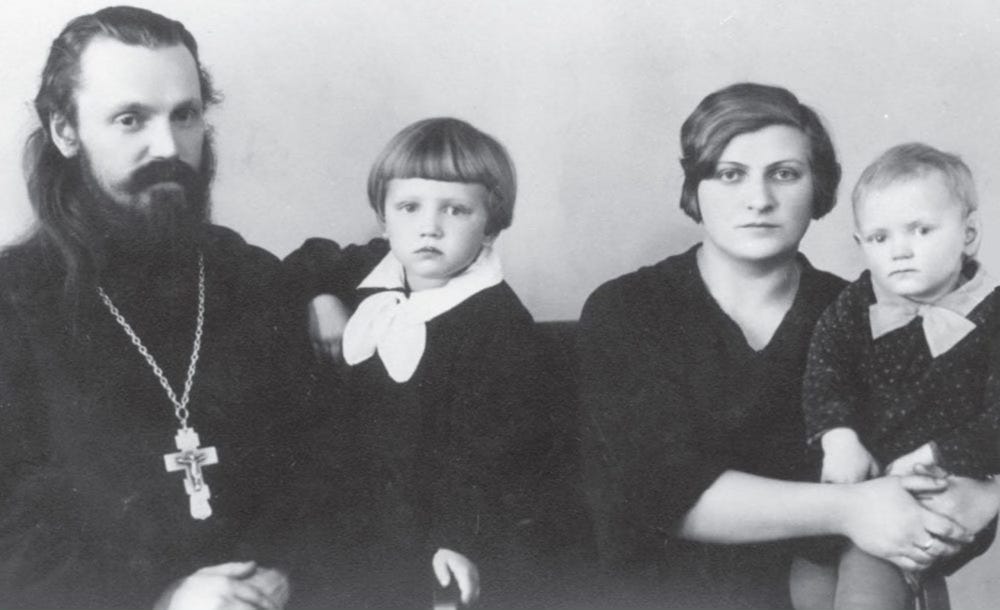
Fr. John Legkii (later ROCOR Bishop John) and, Matushka Ekaterina with their daughters Iraida, left and Galina, right. Latvia. Photo: I. Legkii, Letaiushchii arkhierei [A Flying Bishop] (Moscow 2014)
Archbishop John of Riga, the future martyr, ordained John a deacon on September 14, 1931, and a priest on September 21 of the same year. In 1936, he was assigned to Riga Holy Trinity-St. Sergius Convent and appointed a teacher of law for local schools. From 1936–1944, he was a member of the Riga Diocesan Council.
In June 1941, the NKVD arrested Fr. John and imprisoned him in Ostrov city prison, the Pskov region. Only the advance of Wehrmacht secured his release. From 1941–1944, Fr. John with was a member of the missionary team working on the Christianization of Pskov Region together with Fr. Liverii Voronov and Protopresbyter Alexey Ionov.
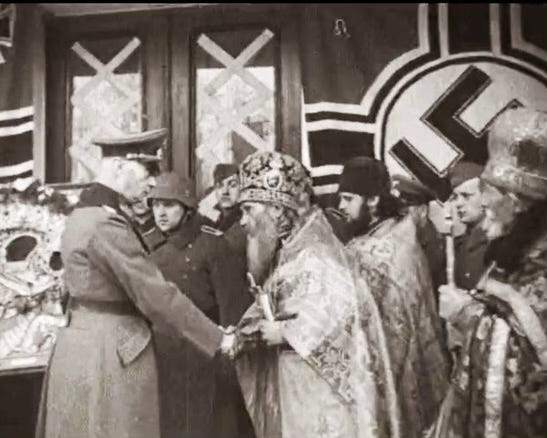
The moment when the Tikhvin Icon of the Mother of God was transferred to the clergy in Pskov by the Wehrmacht, who took the icon from the Tikhvin Assumption Monastery in the Leningrad region of Russia. Such actions had propagandist value to convince audience that unlike the “Godless Reds,” National Socialists supported religion in the occupied regions
At the direction of the German authorities, he participated in the removal of the Tikhvin Icon of the Mother of God from the Riga Trinity-Sergius Convent to Liepaja. The icon was transported on a fishing boat under German escort by him and the priests John Baumanis, Alexeyi Ionov, and Nikolai Perekhvalskii, and handed over to Bishop John (Garklavs).
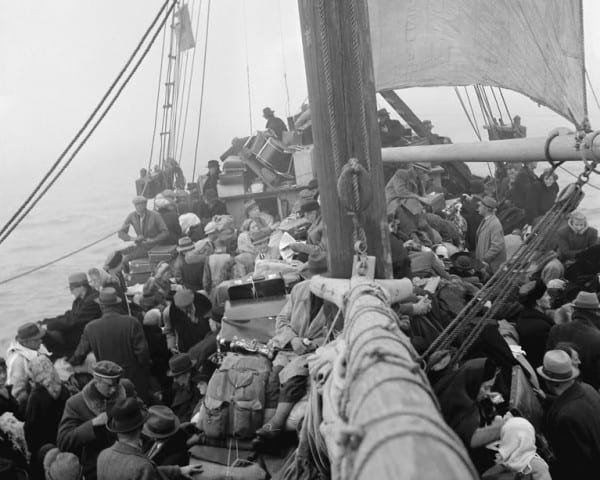
A characteristic photo of the emigration from the Baltics, this image captures the scene going from Tallinn on September 19, 1944. Photo: eesti.ca
In April 1943, he was elevated to the rank of archpriest. In September 1944 Fr. John and his family came to Germany having been required to evacuate.
From 1944, he served in the Russian Orthodox Church Outside of Russia. From 1946–1949, he cared for Russian refugees in the German DP camps, serving as an observer of the teaching of the Law of God in Russian schools in Germany.
He was in the USA from 1949 and served at Holy Ascension Cathedral in the Bronx in New York between 1949 and 1959. From 1959, he was rector of the Church of the Archangel Michael in the city of Paterson, New Jersey, USA.
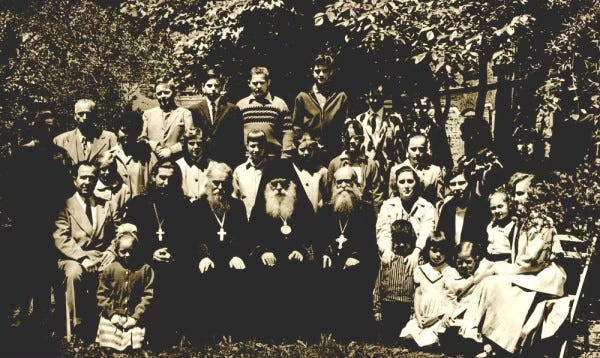
The rector, clergy, teachers and a group of students of the Ascension Cathedral. The men of the cloth left to right: Priest Boris Kizenko, Archpriest John Legkii, Archbishop Nikon (Rklitskii), Archrpiest Sergii Panteleev. Photo: internetsobor.org
From 1949–1987, he was a member of the Eastern American Diocesan Council. In the years from 1961–1987, he held the position of dean. For his long and zealous service to the Church, Father John was deservedly decorated with all the possible awards for a priest. On December 13, 1972, he was elevated to the rank of protopresbyter. He retired in 1987.
On January 14, 1989, his spouse Ekaterina Yakovlevna (née Perminova) died, after which Father John took monastic vows in August 1990, receiving the name of Hieromartyr John, Archbishop of Riga, who ordained him to the priesthood.
On August 15/ 28, 1990, he was consecrated Bishop of Buenos Aires and Argentina and Paraguay. He served in Argentina for four years. In 1994, he was appointed Bishop of Rockland, Vicar of the Eastern American Diocese.
He died peacefully on March 9, 1995, on Clean Friday, in Cliffside Park, New Jersey, USA. Bishop John was buried in the cemetery of the Novo-Diveevo Convent. Vechnaia emu pamiat’! (May his memory be eternal!)
Source
Iraida, Legkaia (Pushkareva), Letaiushchii arkhierei [A Flying Bishop] (Moscow 2014).
Relevant Sources
Anatolij Kinstler, “Baltic Orthodoxy in the Archives of the German Diocese of the ROCOR”
Alexander V. Gavrilin, “Latvian Orthodox Clergy in Western Germany, 1945–1949”